

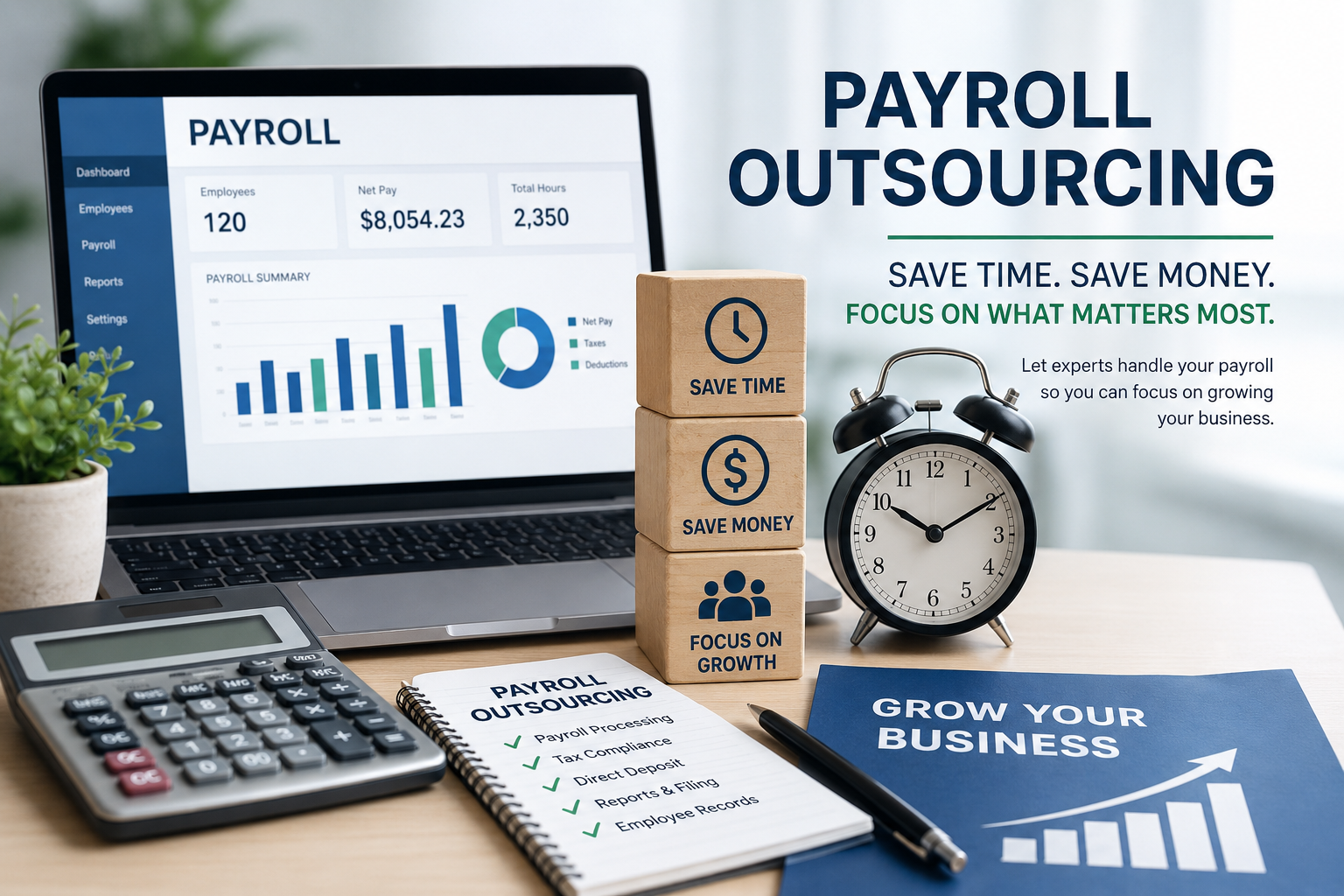
For small business owners, managing payroll can quickly become a time-consuming administrative responsibility. Calculating employee wages, processing deductions, managing payroll taxes, maintaining employee records, and ensuring payroll is completed on time all require attention to detail.
As a business grows, payroll becomes even more complicated. More employees can mean more payroll records, additional benefits and deductions, changing tax requirements, and greater administrative work.
This is where payroll outsourcing for small businesses can provide significant value.
Instead of managing the entire payroll process internally, businesses can work with an experienced payroll service provider to handle payroll administration and related responsibilities. Outsourcing payroll can help reduce administrative workloads, minimize costly errors, improve compliance, and allow business owners and employees to focus on more important business activities.
But how much time and money can payroll outsourcing actually save?
Let’s take a closer look.
What Is Payroll Outsourcing?
Payroll outsourcing is the process of hiring an external payroll service provider to manage some or all of a company’s payroll-related activities.
Depending on the provider and the business’s requirements, outsourced payroll services may include:
- Employee payroll processing
- Wage and salary calculations
- Payroll tax calculations
- Payroll tax filings
- Direct deposit processing
- Employee payment management
- Payroll deductions
- Employee record maintenance
- Payroll reporting
- Year-end payroll support
- Payroll compliance assistance
- Payroll administration
For a small business, outsourcing these responsibilities can eliminate many of the repetitive administrative tasks associated with payroll.
Businesses can also choose the level of support they need. Some may outsource the entire payroll process, while others may outsource specific tasks such as payroll tax calculations or payroll reporting.
For businesses looking for broader financial support, payroll can also be integrated with accounting and bookkeeping services to create a more efficient financial administration process.
Why Is Payroll So Time-Consuming for Small Businesses?
Payroll may appear straightforward when a business has only a few employees. However, payroll involves much more than simply calculating hours and issuing paychecks.
A business may need to manage:
- Employee hours and overtime
- Salaries and wages
- Federal, state, and local payroll taxes
- Employee tax withholdings
- Benefits and other deductions
- Paid time off
- Payroll records
- Tax filings and deadlines
- Employee changes
- Year-end reporting
Even a small mistake can create additional administrative work.
For example, if an employee’s hours are entered incorrectly, payroll may need to be recalculated. If a tax filing deadline is missed, the business may have to spend additional time resolving the issue.
For a small business owner who is already responsible for sales, operations, customer service, hiring, and business development, spending hours every pay period on payroll administration can become a significant burden.
-
Payroll Outsourcing Saves Valuable Business Time
One of the biggest benefits of outsourcing payroll is the amount of time it can save.
Payroll is a recurring process. Depending on the company’s payroll schedule, employees may need to be paid weekly, biweekly, semi-monthly, or monthly. Each payroll cycle requires preparation, review, processing, and record keeping.
When payroll is handled internally, someone must spend time gathering information, calculating wages, reviewing deductions, processing payments, and preparing reports.
With an outsourced payroll service, much of this administrative workload can be transferred to a dedicated payroll team.
This gives business owners and internal employees more time to focus on activities that directly contribute to business growth.
For example, instead of spending several hours each payroll period reviewing payroll spreadsheets, a business owner could use that time to:
- Meet with customers
- Develop new business
- Improve operations
- Manage employees
- Work on marketing
- Develop new products or services
- Build strategic partnerships
The value of payroll outsourcing isn’t simply the number of hours saved. It is also what the business can accomplish with those additional hours.
-
Outsourcing Can Reduce Payroll Processing Costs
Payroll has both direct and indirect costs.
Direct costs can include payroll software, administrative tools, training, and employee wages associated with payroll processing.
Indirect costs can be more difficult to identify.
For example, suppose an employee spends several hours every pay period managing payroll. That employee’s time has a cost. If the business owner handles payroll personally, the cost may be even greater because the owner’s time could potentially be spent generating revenue or managing business growth.
Outsourcing payroll allows businesses to convert some of these internal administrative costs into a predictable service expense.
The actual savings will vary depending on the company’s size, payroll complexity, employee count, and service provider. However, businesses should evaluate payroll outsourcing based on the total cost of managing payroll internally, rather than comparing only the monthly outsourcing fee with the cost of payroll software.
-
Payroll Outsourcing Helps Reduce Costly Errors
Payroll errors can be expensive.
A mistake in employee hours, tax calculations, deductions, or payroll records can result in additional administrative work and potentially create employee dissatisfaction.
For example, an incorrect paycheck can require:
- Researching the problem
- Recalculating payroll
- Communicating with the employee
- Correcting payroll records
- Processing an adjustment
- Reviewing the process to prevent future errors
Payroll mistakes can also damage employee trust. Employees expect their paychecks to be accurate and delivered on time.
Working with an experienced payroll processing service can help businesses establish a more consistent and structured payroll process.
-
Payroll Outsourcing Can Help With Tax Compliance
Payroll tax compliance is one of the most important responsibilities associated with payroll.
Businesses must ensure that applicable payroll taxes are calculated correctly, records are maintained, and required filings are completed according to applicable requirements.
Tax requirements can also change over time, making payroll administration more difficult for businesses that do not have dedicated payroll expertise.
Outsourcing payroll can provide access to professionals who regularly work with payroll processes and compliance requirements.
While no service provider can eliminate every compliance risk, having an experienced team manage payroll can help reduce the likelihood of avoidable administrative mistakes.
Businesses should always select a payroll provider that understands the requirements applicable to their business location and workforce.
-
Payroll Outsourcing Reduces the Need for Additional Payroll Staff
As a business grows, its administrative workload grows as well.
A company that initially manages payroll using its owner or office administrator may eventually find that payroll requires too much time for one employee to handle alongside other responsibilities.
At that point, the business may consider hiring a dedicated payroll employee.
Hiring additional staff involves more than salary. Businesses may also have to consider:
- Payroll taxes
- Benefits
- Training
- Software
- Equipment
- Office resources
- Paid time off
- Recruitment costs
Outsourcing payroll can provide access to payroll expertise without necessarily requiring the business to build a dedicated internal payroll department.
This can be particularly useful for small and growing businesses that need professional payroll support but don’t yet need a full-time payroll employee.
-
Payroll Outsourcing Provides Greater Scalability
Payroll processes that work for five employees may not work as efficiently for 25, 50, or 100 employees.
As employee numbers increase, payroll becomes more complex.
New employees must be added, terminated employees must be removed, compensation may change, benefits may change, and payroll records must remain accurate.
An outsourced payroll provider can help businesses manage this growth without requiring the internal payroll process to be completely rebuilt every time the company expands.
This makes small business payroll services particularly valuable for companies that expect to grow.
-
Employees Can Receive More Consistent Payroll Support
Payroll isn’t only about the business. It directly affects employees.
Employees may have questions about:
- Paychecks
- Tax withholdings
- Deductions
- Direct deposits
- Payroll records
- Paid time off
- Year-end documents
When payroll is managed internally by someone who already has multiple responsibilities, responding to employee payroll questions can create additional interruptions.
A professional payroll service can provide a structured process for handling payroll-related questions and maintaining payroll information.
A more organized payroll process can improve the overall employee experience.
-
Business Owners Can Focus on Growing the Business
Perhaps the most important benefit of payroll outsourcing is the ability to focus on the business itself.
Small business owners often wear multiple hats. They may be responsible for sales, customer relationships, operations, hiring, financial management, marketing, and strategic planning.
Payroll is necessary, but it may not be the best use of the owner’s time.
Outsourcing administrative responsibilities allows owners to spend more time on activities that can contribute directly to revenue and growth.
For example, the time saved from payroll administration could be redirected toward acquiring new customers, improving customer retention, or developing new services.
In this way, payroll outsourcing is not simply an administrative expense. It can be viewed as an investment in operational efficiency.
-
Payroll Outsourcing Improves Business Continuity
Another potential advantage of outsourcing payroll is business continuity.
When payroll is handled by one internal employee, the business may become dependent on that person’s knowledge of the payroll process.
If that employee is on vacation, becomes unavailable, or leaves the company, payroll responsibilities may suddenly become difficult for someone else to manage.
An outsourced payroll provider typically has processes and teams designed to maintain payroll operations.
This can provide additional continuity and reduce dependence on a single internal employee.
-
Payroll Outsourcing Can Complement Accounting Services
Payroll is closely connected to a company’s overall financial operations.
Payroll information may need to be reflected in accounting records, financial statements, and other business reports.
Managing payroll and bookkeeping through disconnected processes can create unnecessary duplication.
For businesses that want to streamline their financial administration, combining payroll with outsourced bookkeeping services can create a more coordinated workflow.
This can help businesses maintain more organized financial records while reducing the amount of administrative work handled internally.
Is Payroll Outsourcing Right for Your Small Business?
Payroll outsourcing may be a good option if your business:
- Has limited administrative staff
- Is experiencing rapid employee growth
- Frequently spends significant time processing payroll
- Has experienced payroll errors
- Wants help managing payroll compliance
- Doesn’t want to hire a dedicated payroll employee
- Wants to reduce administrative workload
- Wants business owners to focus more on growth
- Needs more consistent payroll processes
The right approach depends on your business size, employee count, payroll frequency, locations, and specific payroll requirements.
Before selecting a provider, businesses should evaluate the provider’s experience, services, technology, security practices, customer support, pricing, and ability to scale with the organization.
You can also review our payroll services for small businesses to learn more about how outsourced payroll support can fit into your business operations.
How to Choose a Payroll Service Provider
Not all payroll providers offer the same services.
Before making a decision, consider asking the following questions:
Does the provider understand your business needs?
A small business may have very different payroll requirements from a large corporation. Choose a provider that understands the needs of businesses similar to yours.
What payroll services are included?
Find out whether the provider handles payroll processing, tax-related responsibilities, employee records, reporting, and other services you require.
How secure is employee payroll information?
Payroll contains sensitive employee and financial information. Ask potential providers about their data security procedures, access controls, and privacy practices.
Is customer support available when you need it?
Payroll operates on deadlines. Make sure you understand how and when you can contact your payroll provider if a problem occurs.
Can the provider scale with your business?
Choose a provider that can support your organization as the number of employees and complexity of your payroll increase.
Final Thoughts: Is Payroll Outsourcing Worth It?
For many small businesses, payroll outsourcing can be an effective way to reduce administrative work, improve efficiency, and control the costs associated with payroll management.
The biggest benefit may not simply be the cost of payroll processing itself. It is the opportunity to recover valuable time and redirect internal resources toward activities that help the business grow.
Instead of spending hours every pay period managing payroll spreadsheets, calculations, records, and administrative tasks, business owners can rely on an experienced payroll team to manage the process.
At the same time, outsourcing can help reduce payroll errors, support compliance, provide scalability, and eliminate the need to build a large internal payroll function.
If your business is spending too much time managing payroll, it may be worth evaluating whether payroll outsourcing for small businesses could provide a more efficient and cost-effective solution.
Ready to simplify your payroll process? Explore our Payroll Services to see how professional payroll support can help your business save time, reduce administrative workload, and focus on growth.