

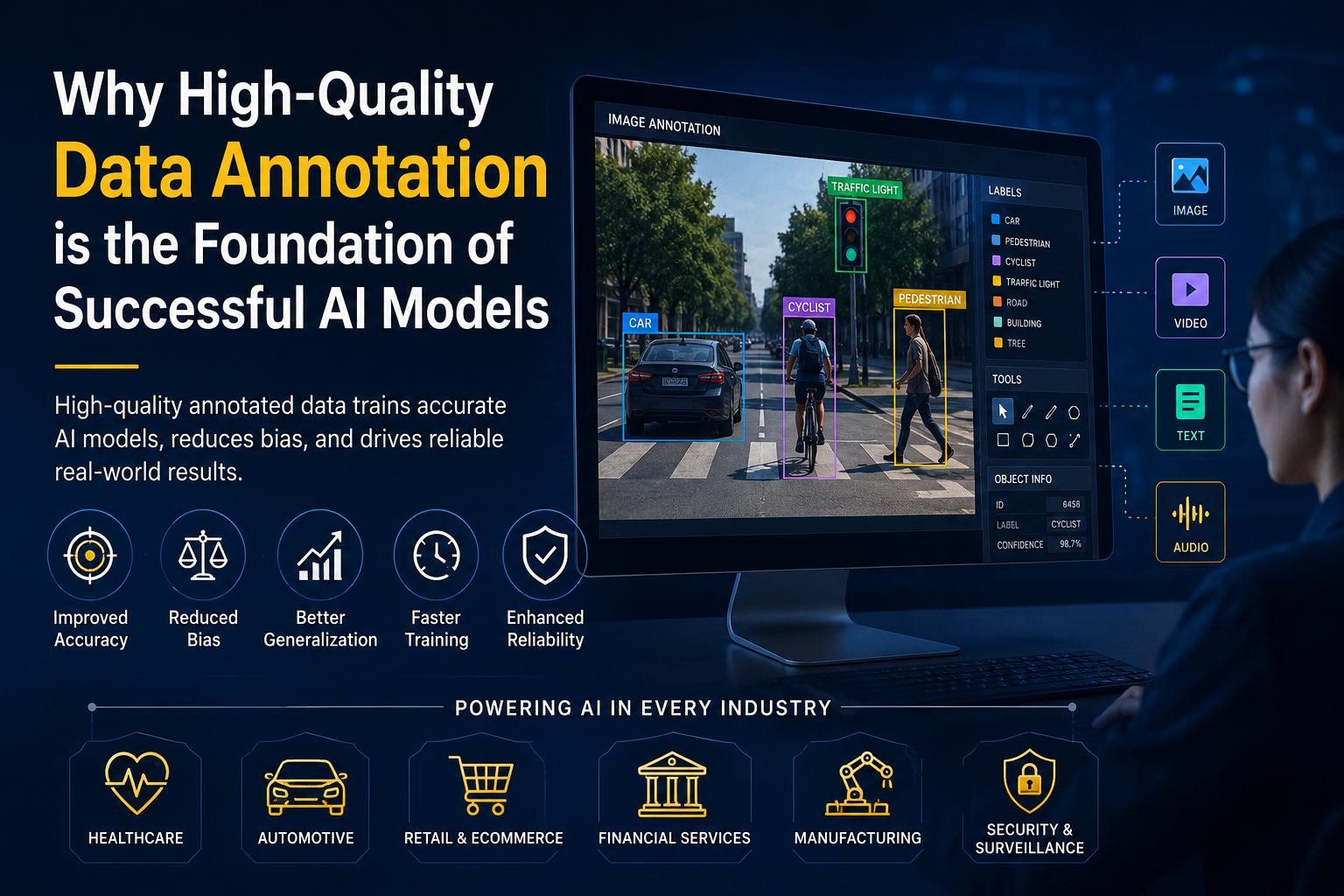
Artificial Intelligence (AI) has transformed the way businesses operate, enabling organizations to automate processes, gain valuable insights, and deliver enhanced customer experiences. From self-driving cars and medical diagnostics to recommendation engines and intelligent chatbots, AI-powered applications are becoming an integral part of modern business operations.
However, behind every successful AI model lies a critical yet often overlooked component—high-quality data annotation. No matter how advanced an AI algorithm may be, its performance largely depends on the quality of the data used for training. Poorly labelled data can lead to inaccurate predictions, biased outcomes, and unreliable AI systems. Conversely, accurately annotated datasets enable AI models to learn effectively, improve accuracy, and deliver dependable results.
In this blog, we will explore why high-quality data annotation is the foundation of successful AI models, its importance across industries, and how businesses can benefit from professional data annotation services.
Understanding Data Annotation
Data annotation is the process of labelling, tagging, or categorizing data so that machine learning models can recognize patterns and learn from them. The annotated data serves as the “ground truth” that AI systems use during training.
Data annotation can be applied to various data types, including:
- Images
- Videos
- Text
- Audio
- Documents
- Sensor Data
The annotation process involves identifying specific objects, features, sentiments, entities, or actions within a dataset and assigning appropriate labels. These labels help AI algorithms understand relationships and make accurate predictions when exposed to new data.
Why AI Models Depend on Data Annotation
Machine learning algorithms do not inherently understand images, text, or audio. They learn by analyzing examples and identifying patterns within labelled datasets.
For example:
- An autonomous vehicle learns to identify pedestrians, traffic signs, and vehicles through annotated images and videos.
- A healthcare AI system detects abnormalities by studying labelled medical images.
- A customer support chatbot understands user intent through annotated text datasets.
- An eCommerce recommendation engine learns customer preferences through labelled behavioural data.
Without properly annotated data, AI systems would struggle to distinguish between different objects, sentiments, or actions, resulting in poor performance.
The Relationship Between Data Quality and AI Accuracy
The phrase “Garbage In, Garbage Out” perfectly applies to AI development. Regardless of how sophisticated an AI model may be, poor-quality training data inevitably produces poor-quality results.
High-quality annotations provide:
Improved Model Accuracy
Accurate labels help AI models correctly identify patterns and relationships. The more precise the annotations, the more accurate the model becomes during prediction and classification tasks.
Reduced Bias
Incorrect or inconsistent annotations can introduce bias into AI systems. High-quality annotation practices ensure balanced and representative datasets that reduce the risk of biased outcomes.
Better Generalization
Well-annotated datasets allow AI models to perform effectively in real-world scenarios rather than only within controlled training environments.
Faster Training Cycles
Clean and consistent data reduces confusion during training, enabling machine learning models to converge faster and achieve better results.
Enhanced Reliability
Businesses deploying AI solutions require dependable performance. Accurate annotations contribute directly to consistent and trustworthy outputs.
Types of Data Annotation Used in AI Projects
Different AI applications require different annotation techniques.
Image Annotation
Image annotation involves labelling objects, boundaries, and features within images.
Common techniques include:
- Bounding Boxes
- Polygon Annotation
- Semantic Segmentation
- Instance Segmentation
- Keypoint Annotation
- Landmark Annotation
Image annotation is widely used in:
- Autonomous vehicles
- Retail analytics
- Medical imaging
- Security surveillance
- Manufacturing quality control
Video Annotation
Video annotation extends image annotation by tracking objects and actions across multiple frames.
Applications include:
- Traffic monitoring
- Autonomous navigation
- Sports analytics
- Behavioral analysis
- Security systems
Text Annotation
Text annotation involves labelling words, phrases, or sentences to help natural language processing (NLP) systems understand language.
Examples include:
- Sentiment Analysis
- Named Entity Recognition (NER)
- Intent Classification
- Text Categorization
Text annotation powers:
- Chatbots
- Virtual assistants
- Customer support automation
- Social media monitoring
Audio Annotation
Audio annotation labels speech, sounds, emotions, and acoustic events.
Common applications include:
- Speech recognition
- Voice assistants
- Call center analytics
- Healthcare monitoring
Challenges of Poor-Quality Data Annotation
Many organizations underestimate the complexity of data annotation and attempt to accelerate projects by compromising quality. This often leads to significant challenges.
Inconsistent Labelling
Different annotators may interpret labelling guidelines differently, creating inconsistencies across the dataset.
Human Errors
Manual annotation can introduce mistakes that negatively impact model performance.
Dataset Bias
Unbalanced datasets can result in biased AI systems that perform poorly for certain user groups or scenarios.
Increased Development Costs
Poor annotation quality often requires extensive rework, increasing project timelines and costs.
Reduced AI Performance
Ultimately, inaccurate annotations lead to unreliable predictions and lower business value from AI investments.
Characteristics of High-Quality Data Annotation
Successful AI projects prioritize annotation quality through well-defined processes and quality control mechanisms.
Key characteristics include:
Accuracy
Labels must precisely represent the underlying data.
Consistency
Annotation guidelines should be applied uniformly across the dataset.
Completeness
All relevant objects, entities, or events should be properly labelled.
Scalability
Annotation processes should support large datasets without sacrificing quality.
Quality Assurance
Multiple review stages and validation procedures help maintain annotation standards.
Industries Benefiting from High-Quality Data Annotation
Healthcare
Healthcare organizations use annotated medical images and clinical data to train AI systems for:
- Disease detection
- Radiology analysis
- Medical imaging diagnostics
- Patient monitoring
Accurate annotation is essential because even small errors can significantly impact patient outcomes.
Automotive
Self-driving vehicle technology depends heavily on annotated datasets to recognize:
- Vehicles
- Pedestrians
- Road signs
- Lane markings
- Traffic signals
High-quality annotations improve safety and navigation accuracy.
Retail and eCommerce
Retail businesses use annotated datasets for:
- Product recognition
- Visual search
- Recommendation systems
- Customer behavior analysis
AI-powered retail solutions rely on precise annotations to enhance customer experiences and increase sales.
Financial Services
Financial institutions use annotated datasets for:
- Fraud detection
- Risk assessment
- Customer support automation
- Document processing
Accurate data labelling improves decision-making and operational efficiency.
Manufacturing
Manufacturers leverage annotated visual datasets for:
- Defect detection
- Predictive maintenance
- Quality assurance
- Process automation
Reliable annotations help improve production quality and reduce operational costs.
The Importance of Human Expertise in Data Annotation
Although AI-assisted annotation tools continue to evolve, human expertise remains essential for producing high-quality datasets.
Human annotators provide:
- Contextual understanding
- Domain-specific knowledge
- Judgment in complex scenarios
- Quality validation
- Bias detection
The most effective annotation workflows combine advanced automation with skilled human reviewers through a Human-in-the-Loop (HITL) approach.
This hybrid model ensures efficiency while maintaining the accuracy required for enterprise AI projects.
Why Businesses Choose Professional Data Annotation Services
Many organizations find that outsourcing annotation tasks provides better results than building large in-house teams.
Benefits of professional data annotation services include:
Access to Skilled Annotators
Experienced annotation teams understand industry best practices and quality standards.
Faster Project Completion
Dedicated teams can process large datasets efficiently without compromising quality.
Cost Efficiency
Outsourcing eliminates the need to recruit, train, and manage internal annotation staff.
Scalability
Projects can scale rapidly as data volumes grow.
Quality Control
Professional providers implement robust quality assurance processes that ensure dataset accuracy.
Organizations seeking reliable AI training datasets often partner with specialized providers offering comprehensive Data Annotation Services to achieve higher-quality outcomes and accelerate AI development initiatives.
Best Practices for Ensuring Annotation Quality
To maximize AI model performance, businesses should adopt the following best practices:
Develop Clear Annotation Guidelines
Detailed instructions reduce ambiguity and improve consistency across annotators.
Implement Multi-Level Quality Checks
Independent reviews help identify and correct annotation errors.
Use Domain Experts
Industry-specific knowledge improves annotation accuracy for specialized applications.
Monitor Performance Metrics
Track accuracy, agreement rates, and quality scores throughout the annotation process.
Continuously Refine Datasets
AI datasets should be regularly updated and improved to maintain performance over time.
The Future of Data Annotation in AI
As AI adoption continues to expand, the demand for high-quality annotated datasets will increase significantly.
Emerging trends include:
- AI-assisted annotation tools
- Active learning workflows
- Synthetic data generation
- Human-in-the-loop validation
- Real-time annotation systems
- Industry-specific annotation frameworks
Despite advances in automation, human oversight will remain critical for ensuring accuracy, reducing bias, and maintaining dataset quality.
Organizations that invest in superior annotation practices today will be better positioned to develop reliable, scalable, and competitive AI solutions in the future.
Conclusion
Artificial Intelligence is only as good as the data used to train it. High-quality data annotation provides the foundation upon which successful AI models are built, enabling systems to learn accurately, make reliable predictions, and perform effectively in real-world environments.
From healthcare and autonomous vehicles to retail and finance, organizations across industries depend on accurately labelled datasets to unlock the full potential of AI. Poor-quality annotations can undermine even the most sophisticated machine learning algorithms, while high-quality annotations significantly improve accuracy, reliability, and business outcomes.
For businesses looking to build robust AI solutions, investing in professional Data Annotation Services is not simply a support function—it is a strategic advantage that directly impacts the success of AI initiatives.
By prioritizing annotation quality, organizations can create stronger datasets, develop more intelligent models, and achieve better results from their AI investments.