

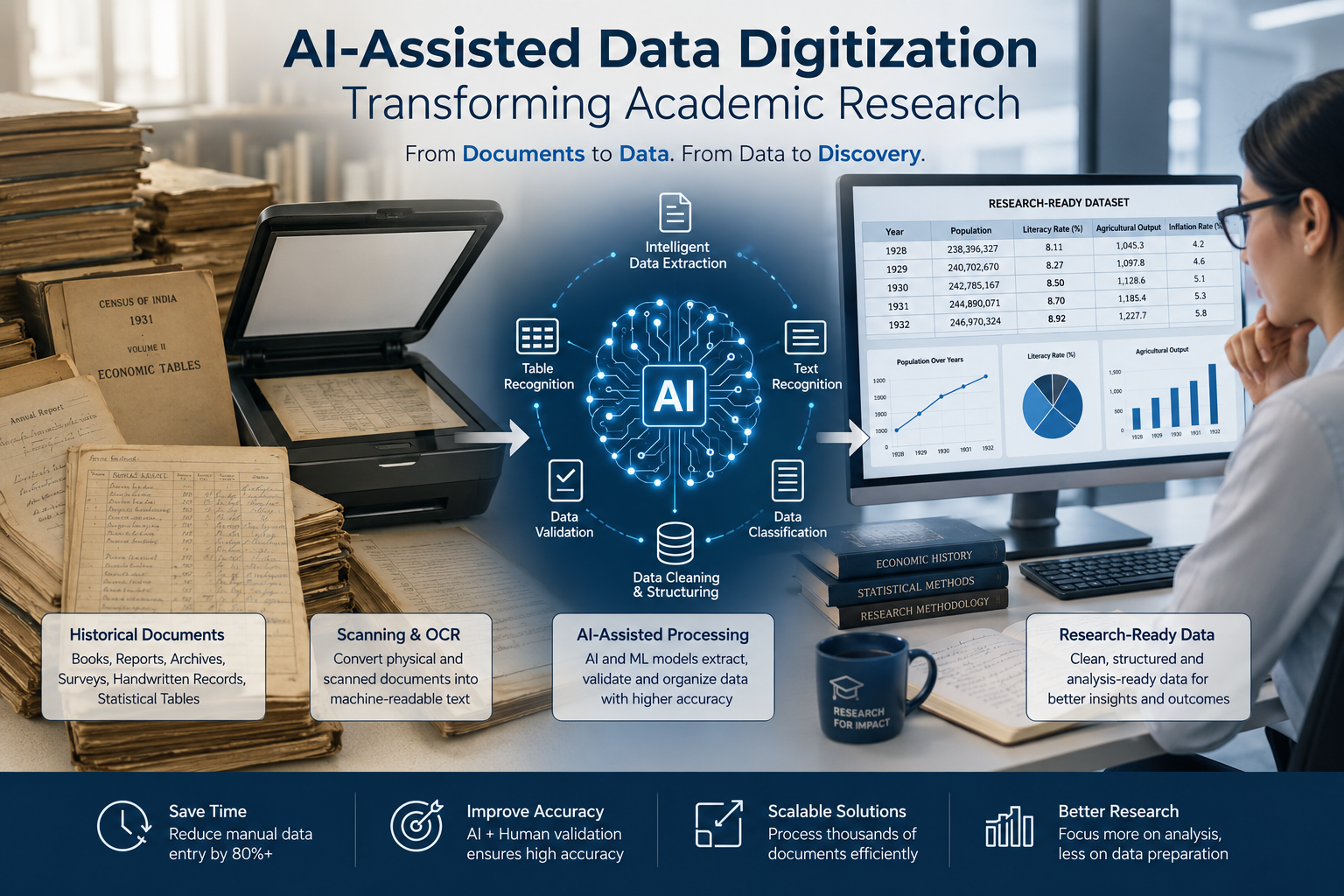
Academic research often begins with information that was never created for modern data analysis. Researchers may work with scanned books, historical records, handwritten documents, government reports, survey forms, newspapers, research papers, statistical tables, archival materials, and thousands of pages of PDFs.
The challenge is not always finding the information. The bigger challenge is turning that information into structured, searchable, and research-ready data.
This is where AI-assisted data digitization is changing the way academic research is conducted.
By combining artificial intelligence, optical character recognition (OCR), intelligent document processing, automated data extraction, and human quality control, universities and researchers can convert large volumes of unstructured information into usable datasets more efficiently.
Instead of spending weeks or months manually entering information from documents, researchers can use AI-assisted workflows to accelerate data preparation while maintaining appropriate validation and accuracy controls.
What Is AI-Assisted Data Digitization?
AI-assisted data digitization is the process of using artificial intelligence and related technologies to convert information from physical or unstructured digital documents into structured, usable digital data.
Traditional digitization may involve scanning documents and manually entering information into spreadsheets or databases. AI-assisted digitization adds intelligent technologies to automate or accelerate many of these steps.
A typical workflow may look like this:
Physical documents → Scanning → OCR → AI-assisted extraction → Data validation → Data cleaning → Structured dataset
Depending on the project, the source material could include:
- Historical documents
- Government publications
- Economic reports
- Census records
- Research papers
- Books and journals
- Survey forms
- Newspapers
- Handwritten records
- Financial documents
- Statistical tables
- Institutional archives
- PDF files
- Images and scanned documents
The final output can be structured into formats such as Excel, CSV, databases, XML, JSON, or other formats required by the research team.
Why Data Preparation Is a Challenge for Academic Researchers
Researchers are often highly focused on developing research questions, reviewing literature, conducting analysis, and interpreting results. However, significant time can be spent on a less visible part of the research process: preparing the data.
Consider a graduate student researching economic trends over several decades.
The student may need to collect information from hundreds of historical reports. Many of these reports may only be available as scanned PDFs. Some may contain tables, while others may contain older typefaces, poor-quality scans, or handwritten annotations.
Manually copying this information into a spreadsheet can be:
- Time-consuming
- Repetitive
- Difficult to scale
- Vulnerable to transcription errors
- Difficult to validate
- Distracting from higher-value research activities
AI-assisted data digitization can help address these challenges by automating portions of the document-to-data workflow.
How AI-Assisted Digitization Supports Academic Research
-
Converting Scanned Documents into Searchable Data
Many valuable research sources exist only in scanned form.
Historical publications, archival documents, old research materials, newspapers, government reports, and institutional records may not contain selectable text.
OCR technology can recognize text within scanned images and convert it into machine-readable content.
AI-assisted OCR can go beyond simple character recognition by helping process documents with different layouts, fonts, tables, and formatting.
For researchers, this can make large document collections significantly easier to search, organize, and process.
For projects involving large document collections, universities can also consider specialized Document Digitization Services to convert physical and scanned materials into structured digital information.
-
Extracting Data from Tables and Reports
Academic research frequently involves statistical tables.
Economic reports, government publications, annual reports, census documents, and historical studies may contain valuable information in tables rather than ordinary paragraphs.
Extracting this information manually can require substantial effort.
AI-assisted extraction can help identify:
- Table structures
- Column headings
- Row labels
- Numerical values
- Dates
- Categories
- Units of measurement
- Other relevant fields
The extracted information can then be reviewed and transformed into a structured dataset.
This is particularly useful when researchers need to compare information across many documents or years.
-
Processing Historical Research Materials
Historical research often depends on documents that were created long before modern digital systems existed.
Researchers may need to analyze:
- Historical newspapers
- Census records
- Economic publications
- Government reports
- Trade records
- Historical surveys
- Archival correspondence
- Institutional records
- Printed books
- Old statistical reports
Digitizing these materials can make them easier to search and analyze.
For example, an economics researcher studying changes in employment, prices, trade, or population over a long period may need to extract information from reports published decades ago.
Rather than manually entering every data point, an AI-assisted digitization workflow can help convert the source material into a structured dataset that can subsequently be reviewed and analyzed.
-
Supporting Large-Scale Research Projects
The volume of research data can become a major challenge.
A project involving 20 documents may be manageable manually. A project involving 2,000 or 20,000 documents is a very different proposition.
AI-assisted processing can help researchers handle larger document collections by automating repetitive tasks.
For example, a research team could establish a standardized workflow for:
- Receiving documents
- Scanning or processing digital files
- Applying OCR
- Extracting required information
- Classifying documents
- Structuring the extracted information
- Performing quality checks
- Cleaning the data
- Delivering the final dataset
Automation does not eliminate the need for human review. Instead, it can reduce the amount of repetitive manual work that researchers and research assistants have to perform.
AI-Assisted Data Digitization and Economics Research
Economics departments are one area where these technologies can have practical applications.
Economic research frequently involves large quantities of historical and statistical information.
Researchers may need to work with:
- Census data
- Government economic reports
- Employment statistics
- Inflation data
- Trade statistics
- Agricultural statistics
- Industry reports
- Historical price data
- Company records
- Financial publications
- Survey responses
Much of this information may exist in documents rather than ready-to-use databases.
AI-assisted data extraction can help transform these sources into structured research datasets.
For example, a researcher studying historical inflation may need to collect price information from publications covering multiple years. Instead of manually transcribing every table, an AI-assisted workflow can identify and extract relevant information, followed by validation and correction.
The result can be a more organized dataset that is easier to analyze using tools such as Excel, statistical software, Python, R, or other research platforms.
AI-Assisted OCR vs. Traditional OCR
Traditional OCR has been an important technology for document digitization for many years.
However, conventional OCR can struggle with certain types of documents, particularly when they contain:
- Poor-quality scans
- Complex layouts
- Multiple columns
- Tables
- Unusual fonts
- Handwriting
- Stamps or annotations
- Damaged pages
- Mixed content
AI-assisted approaches can add additional processing capabilities to help interpret document structure and context.
However, AI should not be treated as automatically producing perfect data.
A research dataset needs to be trustworthy, and extracted information should be appropriately reviewed and validated.
This is why an effective AI-assisted workflow combines automation with human quality assurance.
The Importance of Human Validation
One of the most important considerations when using AI for academic data processing is accuracy.
AI can dramatically accelerate data extraction, but researchers should not assume that every extracted value is automatically correct.
For research projects, even a relatively small number of incorrect values can affect subsequent analysis.
A robust workflow can therefore include multiple quality-control stages.
For example:
AI extraction → Automated validation → Human review → Data correction → Final quality check
Depending on the project requirements, quality control can focus on:
- Numerical accuracy
- Field completeness
- Formatting
- Duplicate records
- Missing values
- Data consistency
- Table alignment
- Document classification
- OCR errors
This approach allows AI to handle repetitive processing while experienced personnel focus on reviewing exceptions and validating the results.
From Unstructured Documents to Research-Ready Datasets
One of the biggest benefits of data digitization is the transformation of unstructured information into structured data.
Consider a collection of 500 PDF reports.
The original information might look like:
PDF documents → scanned pages → paragraphs → tables → images → charts
After processing, the relevant information could become:
Document ID | Year | Location | Category | Metric | Value | Source
This structure makes it much easier to filter, sort, compare, analyze, and import the information into research software.
Researchers can then spend more time interpreting the data instead of manually preparing it.
This is where professional Data Processing Services can complement academic research teams that need large datasets prepared according to specific project requirements.
Digitizing Handwritten Research Data
Not all academic information is available in printed or typed form.
Researchers may also work with handwritten surveys, field notes, historical registers, questionnaires, interview records, and archival documents.
Handwriting introduces additional challenges for automated recognition.
Depending on the quality and consistency of the handwriting, AI-assisted handwriting recognition may help extract information, but human verification remains particularly important.
For research projects involving handwritten information, a hybrid workflow can be used:
Scan → AI-assisted recognition → Data extraction → Human verification → Structured dataset
This can help reduce the amount of manual transcription while maintaining a review process for difficult or ambiguous entries.
Supporting Research Assistants and Graduate Students
AI-assisted digitization does not necessarily replace research assistants.
Instead, it can change how their time is used.
Instead of spending most of their time copying information from documents, research assistants can focus on tasks such as:
- Reviewing extracted information
- Checking data quality
- Identifying anomalies
- Organizing research sources
- Conducting analysis
- Reviewing literature
- Interpreting findings
- Supporting the research methodology
This can make the overall research workflow more efficient while keeping human judgment involved where it matters.
Data Digitization for University Research Departments
Universities can also benefit from establishing repeatable digitization workflows for research projects.
Different departments may have different requirements.
For example:
Economics: Historical economic reports, statistical tables, census information and market data.
History: Newspapers, books, archival records and historical documents.
Sociology: Surveys, questionnaires, interviews and demographic records.
Political Science: Public records, election documents, historical publications and survey datasets.
Business: Annual reports, market research, financial documents and industry publications.
Healthcare Research: Patient-related research records, surveys, clinical research documents and study materials, subject to applicable privacy and regulatory requirements.
A standardized data digitization process can help departments manage large collections of research material while producing data in formats researchers can use.
Data Security and Research Confidentiality
Academic research can sometimes involve sensitive or confidential information.
Examples may include research participant information, unpublished research, proprietary datasets, personally identifiable information, or restricted institutional records.
Therefore, digitization projects should consider:
- Access controls
- Secure file transfer
- Data confidentiality
- User permissions
- Secure storage
- Data retention
- Data destruction
- Appropriate contractual requirements
- Applicable privacy and regulatory obligations
The specific controls should be determined by the nature of the research project and the requirements of the university or research institution.
What Does the Future of Academic Data Digitization Look Like?
AI-assisted data digitization is likely to become an increasingly important component of research data preparation.
Future workflows may combine:
- AI-powered OCR
- Intelligent document processing
- Automated classification
- Table extraction
- Handwriting recognition
- Natural language processing
- Entity extraction
- Automated data validation
- Human-in-the-loop quality assurance
The goal is not simply to digitize documents.
The larger opportunity is to create structured, searchable, and usable research data from information that was previously difficult to process at scale.
This could make previously underutilized historical and archival information more accessible to researchers.
Choosing the Right Data Digitization Approach for a Research Project
Every research project is different.
A small project involving a few hundred pages may require a straightforward OCR and data entry workflow. A large university research project involving thousands of documents may require document classification, automated extraction, database development, quality assurance, and customized data processing.
Before starting a project, research teams should consider:
- What type of source documents are available?
- Are the documents printed, scanned, or handwritten?
- How many documents need to be processed?
- What information needs to be extracted?
- What output format is required?
- What level of accuracy is required?
- Does the data contain confidential information?
- What quality-control process will be used?
- How will extracted information be validated?
- How will the final dataset be delivered?
Clearly defining these requirements can help create an appropriate digitization workflow.
How 3Alpha Can Support Academic Research Data Projects
At 3Alpha, we support organizations with data digitization, OCR, data extraction, data processing, and related services designed to convert information into structured digital formats.
For academic and university research projects, our workflows can support tasks such as:
- Document digitization
- OCR and Data extraction
- Data entry
- Table and form extraction
- Historical document processing
- Handwritten data transcription
- Data cleaning and validation
- Dataset preparation
- Document indexing and classification
- Large-volume research data processing
Our team can work with different document formats and project-specific data requirements, with workflows designed around the source material and required output.
For universities and research teams that need help converting large collections of documents into structured datasets, Data Digitization Services can provide a practical way to scale data preparation without requiring researchers to perform every repetitive task themselves.
Conclusion
Academic research increasingly depends on the ability to access, organize, and analyze large volumes of information.
However, valuable research material is often locked inside scanned documents, historical publications, handwritten records, PDFs, tables, and archives.
AI-assisted data digitization provides a way to bridge the gap between these unstructured sources and modern research datasets.
By combining AI-powered extraction with OCR, data processing, human validation, and quality control, research teams can accelerate document processing and create structured datasets that are easier to search and analyze.
For graduate students, professors, research assistants, and university departments, this can mean spending less time on repetitive data preparation and more time on the research itself.
The future of academic research is not only about generating new information. It is also about making existing information more accessible, structured, and usable—and AI-assisted data digitization is helping make that possible.