

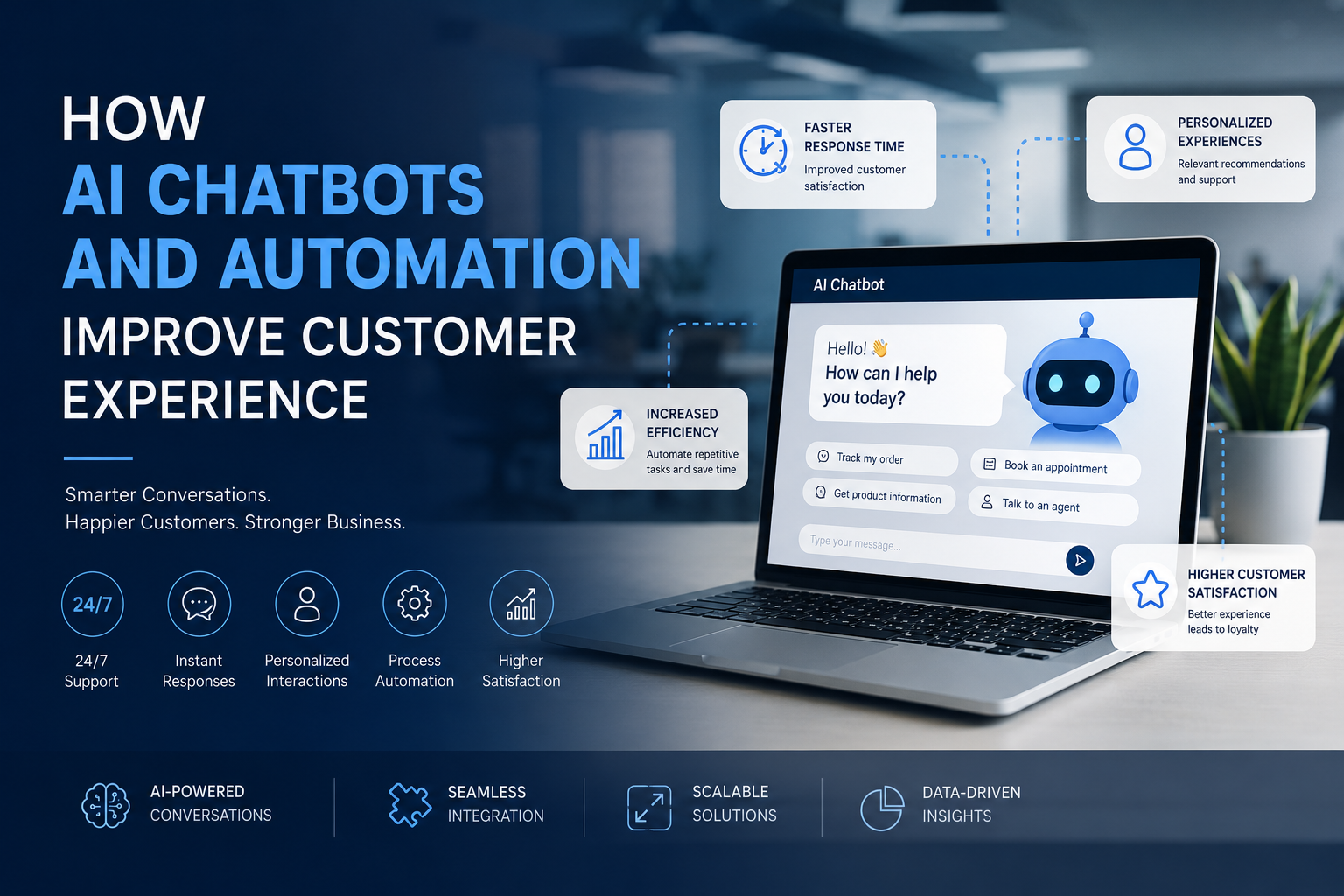
Customer expectations have changed significantly in today’s digital business environment. People expect businesses to respond quickly, provide accurate information, offer convenient communication channels, and deliver personalized experiences. Whether a customer is browsing an online store, scheduling a healthcare appointment, requesting a service quote, or looking for technical support, the quality and speed of the interaction can influence their decision to do business with a company.
However, many businesses still depend on manual processes, traditional phone support, and email-based communication to manage customer inquiries. These methods can create delays, increase administrative workloads, and make it difficult to provide consistent customer service as a business grows.
This is where AI chatbots and automation can make a meaningful difference. By combining artificial intelligence with automated business processes, companies can provide faster responses, improve customer engagement, streamline repetitive tasks, and make their services more accessible.
AI-powered chatbots are no longer limited to answering basic questions. Modern solutions can understand customer requests, guide users through different processes, collect information, recommend relevant services, schedule appointments, and connect with other business applications.
For small and medium-sized businesses, these technologies offer an opportunity to improve customer experience without having to expand customer support teams at the same rate as business growth.
Let’s explore how AI chatbots and business automation are transforming customer interactions and how organizations can benefit from implementing these solutions.
-
What Are AI Chatbots and Customer Experience Automation?
An AI chatbot is a software application designed to communicate with users through natural language. It can interact with customers through a website, mobile application, messaging platform, or other digital communication channels.
Unlike traditional rule-based chatbots that rely on predefined buttons and limited responses, AI-powered chatbots can use natural language processing (NLP) and large language models (LLMs) to understand the intent behind customer questions and generate relevant responses.
For example, a customer visiting a service company’s website might ask:
- What services does your company provide?
- How much does your service cost?
- Can I schedule an appointment for next week?
- How can I check the status of my order?
- Can someone contact me regarding a quotation?
An AI chatbot can understand these requests, retrieve relevant information, and guide the customer toward the next step.
Customer experience automation goes beyond chatbot conversations. It involves using software, integrations, and automated workflows to handle repetitive activities throughout the customer journey.
Examples include:
- Automatically sending appointment confirmations and reminders.
- Capturing customer inquiries and storing them in a CRM.
- Assigning incoming requests to the appropriate department.
- Sending order and service status notifications.
- Following up with customers after an inquiry.
- Collecting customer feedback and service ratings.
When chatbots and automation work together, businesses can create a more connected and convenient customer experience.
-
Providing 24/7 Customer Support and Instant Responses
One of the biggest advantages of AI chatbots is their ability to provide assistance around the clock.
Traditional customer support is generally limited by office hours, staff availability, and the number of inquiries employees can handle simultaneously. Customers who visit a website outside business hours may have to wait until the next working day to receive an answer.
This delay can result in missed sales opportunities, abandoned inquiries, and customer frustration.
AI chatbots help address this challenge by providing continuous access to information and support.
For example, a customer visiting a real estate company’s website at 10 PM may want information about available properties. Instead of waiting for an agent to respond the next morning, the chatbot can answer common questions, collect the customer’s requirements, and request contact details for a follow-up.
Similarly, an eCommerce customer can ask about shipping policies, return procedures, product availability, and payment methods without waiting for a support representative.
Key benefits include:
- Immediate responses to frequently asked questions.
- Customer assistance outside regular business hours.
- Reduced waiting time for basic inquiries.
- Continuous availability across different time zones.
- Fewer missed opportunities caused by delayed responses.
While complex issues may still require human intervention, AI chatbots can handle many routine interactions and make customer support more accessible.
-
Delivering Personalized Customer Interactions
Customers appreciate businesses that understand their needs rather than providing generic information.
AI-powered chatbots can use conversation context, customer preferences, and information from connected business systems to deliver more relevant interactions.
For example, an online retailer can use an AI chatbot to help customers find products based on their preferences, budget, size, or intended use.
A healthcare website could guide visitors toward relevant service information and help them understand the appointment scheduling process. A professional services company could ask visitors about their business requirements and direct them to the appropriate department.
With suitable CRM integration, a chatbot may also recognize returning customers and retrieve relevant information from their customer profiles, subject to appropriate access permissions and privacy controls.
Personalized interactions can help businesses:
- Recommend relevant products and services.
- Guide customers through complex purchasing decisions.
- Reduce the effort required to find information.
- Provide more consistent communication.
- Improve customer engagement and satisfaction.
The objective is not simply to automate conversations. It is to make each interaction more relevant and useful to the customer.
-
Automating Appointment Scheduling and Reservations
Appointment scheduling is one of the most practical applications of AI chatbots and automation.
Many businesses still manage appointments through phone calls, emails, and manual calendar updates. This can consume significant administrative time and create scheduling errors, especially when multiple employees or service locations are involved.
AI-powered appointment booking systems can simplify this process.
A customer can interact with a chatbot, explain the service they need, select an available date and time, and submit their booking request. The system can then connect with a scheduling platform or business calendar to process the appointment.
Depending on the integration, automated workflows can also:
- Display available appointment slots.
- Confirm bookings automatically.
- Send email or SMS confirmations.
- Schedule appointment reminders.
- Allow customers to request rescheduling or cancellation.
- Notify employees about new bookings.
- Update the appointment status in a CRM or scheduling system.
For example, healthcare clinics can use appointment automation to help patients request consultations without having to call the front desk. Hotels and restaurants can use similar systems to manage reservations and customer inquiries.
3Alpha’s AI-powered appointment booking and reservation solutions demonstrate how these technologies can be applied across different industries.
By reducing manual scheduling activities, businesses can improve convenience for customers while allowing employees to focus on more important responsibilities.
-
Improving Lead Generation and Customer Engagement
A website visitor does not automatically become a customer. Businesses need to understand what visitors are looking for, answer their questions, and encourage them to take the next step.
AI chatbots can support this process by acting as an interactive point of contact throughout the visitor’s journey.
Instead of relying entirely on static contact forms, businesses can use chatbots to engage visitors in real time.
For example, a website chatbot for a software development company might ask:
- What type of software or application are you looking to develop?
- What business problem are you trying to solve?
- What is your estimated project timeline?
- How can our team contact you?
Based on the answers, the chatbot can collect relevant information and submit a qualified inquiry to the sales team.
This information can then be automatically transferred to a CRM system, where the sales team can review the inquiry and follow up.
How chatbot-based lead generation helps businesses:
- Engages visitors before they leave the website.
- Captures inquiries outside regular business hours.
- Collects structured information about customer requirements.
- Directs inquiries to the appropriate sales team.
- Reduces manual data entry.
- Supports faster follow-up and lead management.
Businesses can also configure automated follow-up emails and notifications based on the customer’s inquiry or selected service.
When properly implemented, chatbot-driven lead generation can help companies make better use of their existing website traffic.
-
Reducing Customer Service Workloads Through Automation
Customer service teams often spend a considerable amount of time handling repetitive requests.
These may include answering frequently asked questions, providing order updates, confirming appointments, sharing documents, checking account information, and routing inquiries.
Although these activities are necessary, they do not always require direct employee involvement.
Business process automation allows companies to automate repetitive tasks and reduce the amount of manual work involved in customer interactions.
Consider an eCommerce business that receives hundreds of inquiries about order status every week.
Without automation, employees may need to access the order management system, locate the customer’s purchase, check shipping information, and manually respond to each inquiry.
An integrated chatbot can retrieve permitted order information from the relevant system and provide an automated update.
Other examples include:
- Automated invoice and payment notifications.
- Customer onboarding workflows.
- Document submission confirmations.
- Service request tracking.
- Automated email responses.
- Customer feedback collection.
- Internal ticket creation and assignment.
These workflows can improve operational efficiency while allowing employees to concentrate on complex requests that require judgment, experience, or personal attention.
-
Integrating AI Chatbots With CRM and Business Applications
A chatbot becomes significantly more useful when it can communicate with other business applications.
Without integration, a chatbot may simply answer questions. With appropriate integrations, it can become part of a broader business workflow.
For example, connecting a chatbot to a CRM platform allows customer inquiries to be recorded automatically. Sales representatives can access conversation summaries, customer requirements, contact information, and follow-up tasks from a centralized system.
Similarly, integrations with other applications can support:
- CRM systems for customer and lead management.
- Scheduling software for appointment booking.
- eCommerce platforms for order and product information.
- Payment gateways for payment-related workflows.
- Helpdesk systems for support ticket management.
- Email marketing platforms for customer communication.
- Business databases for retrieving approved information.
API integration plays an important role in connecting these systems and enabling information to move between different applications.
For companies that require specialized functionality, custom integration may be more suitable than relying entirely on standard chatbot plugins.
3Alpha provides API development and integration services to help businesses connect web applications, mobile applications, and external software systems.
The result is a more connected customer experience with fewer manual steps and less repetitive data handling.
-
Maintaining Consistent Customer Service Across Multiple Channels
Customers interact with businesses through different channels. Some prefer websites, while others use mobile applications, email, social media, or messaging platforms.
Providing consistent information across all these channels can be challenging, particularly when customer inquiries are managed by separate teams.
AI chatbots can help businesses maintain more consistent communication by using centralized information sources and approved response guidelines.
For example, a company can configure its chatbot using information about:
- Products and services.
- Pricing and service policies.
- Business hours and locations.
- Frequently asked questions.
- Booking and cancellation procedures.
- Customer support processes.
The same approved information can support interactions across multiple channels, depending on the chatbot platform and integrations.
This reduces the risk of customers receiving conflicting information from different communication channels.
Businesses should also establish clear procedures for updating chatbot knowledge whenever services, prices, or policies change.
-
Using AI Chatbots to Improve Customer Experience Across Industries
The benefits of AI chatbots and automation are not limited to technology companies. Organizations across different industries can use these solutions to simplify customer interactions.
Healthcare
Healthcare providers can use AI chatbots to answer general questions about services, explain appointment procedures, collect basic appointment requests, and send reminders.
For example, a clinic website can guide visitors through available services and direct them to the appropriate scheduling process.
Healthcare organizations must ensure that systems handling patient information follow applicable privacy and security requirements, including HIPAA where relevant. Chatbots should not independently diagnose medical conditions or replace professional medical advice.
Retail and eCommerce
Online retailers can use chatbots to assist customers with product discovery, availability, order status, shipping policies, returns, and frequently asked questions.
Personalized product recommendations can also help customers navigate large product catalogs and make purchasing decisions.
Real Estate
Real estate businesses can use AI chatbots to respond to property inquiries, collect buyer or renter requirements, schedule property visits, and route qualified leads to agents.
A chatbot can ask about preferred locations, property types, budget ranges, and expected purchase timelines.
Hospitality and Restaurants
Hotels and restaurants can use chatbot solutions to answer questions about room availability, menus, operating hours, reservations, and special requests.
Integrated systems can also support online ordering, reservation management, and automated confirmations.
Professional and Financial Services
Accounting firms, consultants, insurance providers, and other professional service organizations can use chatbots to collect initial customer information, explain service offerings, schedule consultations, and direct inquiries to the right team.
These applications help businesses provide a more convenient first point of contact while keeping employees involved in important customer decisions.
-
Improving Customer Satisfaction Through Faster Problem Resolution
Customer satisfaction depends not only on how quickly a business responds but also on how effectively it resolves the customer’s problem.
AI chatbots can help customers find answers to common questions, access relevant resources, and follow guided troubleshooting steps.
For example, an IT support company can use a chatbot to collect information about a technical issue, identify the affected device or service, and guide the customer through basic troubleshooting.
If the problem remains unresolved, the chatbot can create a support ticket and transfer the conversation to a technician.
This approach can improve the support experience in several ways:
- Customers receive immediate guidance for common problems.
- Support teams receive better-organized issue descriptions.
- Requests can be categorized and prioritized.
- Relevant information can be collected before escalation.
- Customers can receive automated ticket acknowledgments and updates.
An important part of successful chatbot implementation is knowing when automation should stop and human support should take over.
Businesses should provide a clear escalation option for complicated, sensitive, urgent, or unresolved issues.
-
Best Practices for Implementing AI Chatbots and Automation
Although AI chatbots offer many advantages, successful implementation requires more than simply adding a chatbot widget to a website.
Businesses should first understand their customer service challenges and identify the processes that would benefit most from automation.
Here are some practical recommendations.
Identify repetitive customer interactions
Start by reviewing common customer inquiries and identifying tasks that employees perform repeatedly.
Frequently asked questions, appointment requests, order updates, and initial lead qualification are often good starting points.
Define clear chatbot objectives
Determine what the chatbot should accomplish. Objectives might include reducing response times, capturing more leads, automating appointment requests, or reducing repetitive support inquiries.
Use reliable and updated information
Train or configure the chatbot using accurate business information, approved documents, service descriptions, and frequently asked questions.
Establish a process for reviewing and updating this information regularly.
Integrate with existing business systems
Connect the chatbot to relevant CRM, scheduling, payment, or support applications where appropriate.
Ensure that integrations have suitable access controls and do not expose confidential customer information.
Prioritize data privacy and security
Customer information must be handled responsibly.
Businesses should use secure communication, appropriate authentication, access restrictions, data retention policies, and vendor assessments. Sensitive information should not be collected unless it is genuinely required.
Keep human support available
Not every customer issue should be handled by AI.
Provide clear options for customers to speak with an employee, particularly when dealing with complaints, complex requests, financial issues, or sensitive information.
Monitor performance and improve continuously
Review chatbot conversations and identify areas where responses are incomplete, inaccurate, or unhelpful.
Businesses can measure performance using indicators such as:
- Average first-response time.
- Customer satisfaction ratings.
- Chatbot resolution rate.
- Number of inquiries escalated to employees.
- Qualified leads captured.
- Appointment requests completed.
- Customer service workload.
These measurements help organizations understand whether their automation investments are delivering meaningful improvements.
-
The Future of Customer Experience: Combining AI With Human Expertise
AI technology is evolving rapidly, and customer service applications are becoming more capable.
Modern AI solutions can combine natural language processing, machine learning, business data, workflow automation, and application integrations to support more complex interactions.
AI voice agents are another emerging development. Instead of communicating only through text, customers can interact with automated voice assistants to ask questions, request information, and complete certain tasks.
Businesses may also increasingly use AI to analyze customer conversations, identify common service problems, understand customer preferences, and improve their service processes.
However, the future of customer experience is not about replacing every human interaction with automation.
Customers still value empathy, professional judgment, accountability, and personal attention. AI is most effective when it supports employees and makes routine interactions easier.
A balanced approach combines automated assistance for repetitive tasks with human expertise for situations that require understanding, decision-making, and personal communication.
Conclusion: Make Customer Experience a Competitive Advantage With AI and Automation
Customer experience has become an important factor in business growth, customer retention, and brand reputation. Businesses that respond quickly, communicate effectively, and make their services convenient are better positioned to build long-term customer relationships.
AI chatbots and automation provide practical ways to improve these interactions. From 24/7 customer assistance and personalized communication to automated appointment scheduling, lead generation, CRM integration, and customer support workflows, these technologies can help organizations operate more efficiently.
For small and medium-sized businesses, implementing the right automation solutions can reduce repetitive workloads while improving service accessibility and responsiveness.
At 3Alpha LLC, we help businesses explore technology-driven solutions through custom web and application development, AI-powered software solutions, and system integrations. Our goal is to develop solutions that align with actual business requirements and help organizations improve operational efficiency.
Whether you want to introduce an AI chatbot to your website, automate customer inquiries, integrate a chatbot with your CRM, or develop a customized customer service platform, the right solution starts with understanding your business processes.
Ready to improve your customer experience with AI?
Contact 3Alpha LLC to discuss how AI chatbots, intelligent automation, and custom application development can help your business serve customers better and work more efficiently.
Visit 3Alpha LLC to explore our services and discuss your automation requirements.